
01
Specimen and collection
Collection of a validated biological specimen under a documented protocol.
Specimen requirements, handling, logistics and stability windows are defined for each validated specimen type.

Epigenomic research · DNA methylation · Clinical science
Medical AffairsVERITAS EPI · Research platform
Illustrative visualisation of β values across CpG sites in a sample set. Conceptual figure, not clinical or patient data.

Epigenetic mechanisms regulate gene activity without altering the underlying DNA sequence. DNA methylation is one of these mechanisms, and one of the most extensively studied in aging and disease research.
The inherited genetic sequence. It does not change with environment or lifestyle.
A regulatory layer influencing which genes are active in which tissues.
A chemical mark, typically at CpG dinucleotides, associated with gene regulation.
Methylation patterns shift across the lifespan and are used in research models of biological age.
Coverage histogram, annotated CpG island and per-site methylation calls along a genomic interval. Conceptual figure.

Fig. 04Analytical controls used to assess assay performance.
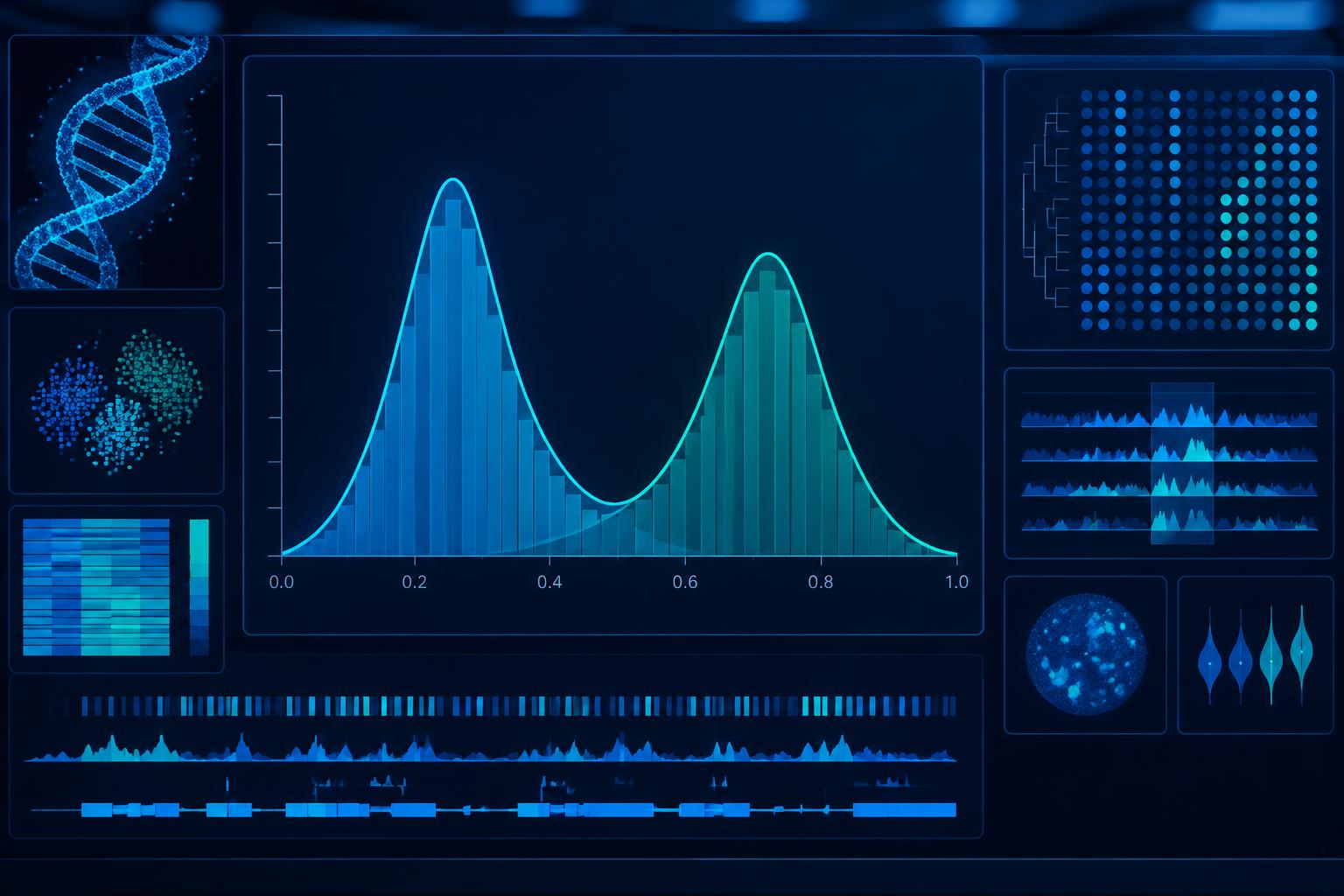
A β value expresses the proportion of methylated signal at a given CpG site, from 0 (unmethylated) to 1 (methylated). Across an array or sequencing panel, the distribution of these values is characteristically bimodal.
Illustrative bimodal density of β values across measured CpG sites. Conceptual figure, not clinical data.
Filled circles denote methylated CpG calls, open circles unmethylated calls, across aligned reads. Conceptual figure.
Epigenomic data passes through defined bioinformatics stages: quality control, normalisation, probe or read filtering, model application and reporting with reference information.
Signal intensity, detection thresholds and sample-level checks.
Correction of technical variation between arrays, batches and runs.
Application of published or internally validated methylation models.
Output presented with reference information, evidence level and limitations.
Conceptual representation of genomic, epigenomic and transcriptomic layers analysed together in research settings.

Fig. 08Computational analysis environment.
Chronological age is time since birth. Biological-aging measures are research constructs derived from molecular data, interpreted only within appropriate scientific and clinical context.
Chronological age
A number
Time since birth, measured directly.
Biological-aging measure
A model output
Derived from methylation data through a defined and referenced model.

Fig. 09Fluorescence microscopy of human cells.
Research context
These associations are reported at population level. Association is not causation, and no individual result is attributed to a single factor.
Only analytically and clinically validated domains are reported. Every domain carries its reference information, evidence level and limitations.
 Domain 01
Validated age-related metric(s), reported with the reference model applied.
 Domain 02
Difference relative to the appropriate reference model, where validated.
 Domain 03
Only validated domains are displayed in a research or clinical report.
 Domain 04
Interpreted alongside conventional metabolic measurement; it does not replace clinical testing.
 Domain 05
How inflammatory pathways intersect with aging research.
 Domain 06
Physical activity, nutrition, sleep and exposures studied in relation to aging biology.

Fig. 10Interpretation takes place within a clinical setting.
Molecular measurements do not diagnose disease. They are one input among clinical history, examination and conventional laboratory investigation.
Each stage is documented, with the sample requirement, laboratory procedure, computational step and reporting rule stated explicitly.
Collection of a validated biological specimen under a documented protocol.
Specimen requirements, handling, logistics and stability windows are defined for each validated specimen type.
DNA extraction and quality assessment prior to conversion.
Extraction yield and integrity are assessed against defined acceptance criteria before a sample proceeds.

Bisulfite conversion and methylation measurement across CpG sites.
Conversion efficiency and control probes are monitored as part of the analytical quality system.

Quality control, normalisation and application of referenced models.
Pipelines, model versions and reference populations are recorded for each analysis.

Structured reporting with evidence level, reference information and limitations.
Statements are separated into mechanistic hypothesis, association, clinical evidence and validated biomarker.

Continuous scientific review and documented validation of methods.
Analytical and clinical validation documentation is published as it is verified.

Rather than comparing products, VERITAS EPI describes what is measured, how it is measured, what the evidence supports and where the limits are.
Specimen type, laboratory procedure, conversion chemistry, measurement platform and control strategy are documented.
Findings are placed alongside conventional clinical measurement and interpreted by a qualified professional.
Mechanistic hypothesis, association, clinical evidence and validated biomarker are reported as distinct categories.
Reference model, reference population and model version accompany every reported measure.
Known limitations of methylation-based measures are stated in the report rather than in fine print.
Methods and reported domains are subject to continuous review as the literature develops.
Editorial rule
Affiliation, accreditation and regulatory statements are published only when the exact relationship, authorisation or certificate has been verified. Published academic work that is not a formal collaboration is described as scientific foundation or research landscape.
Scientific integrity
Questions
No. VERITAS EPI does not predict lifespan and does not estimate life expectancy. It measures epigenetic signals studied in relation to biological aging in research settings and reports them within scientific and clinical context.
No. The analysis is not a diagnostic test for any disease. It does not replace clinical history, examination or conventional laboratory investigation, and results must be interpreted by a qualified healthcare professional.
No. The analysis measures epigenetic marks, particularly DNA methylation. It does not modify DNA and does not alter the genome.
We make no claims about reversing aging. Some factors are described in the literature as associated with epigenetic patterns, but population-level association does not establish that an individual measure can be changed in a defined way.
Epigenomic information requires a high standard of protection. Data handling, storage, retention and consent are described on the Standards page and governed by the approved policies applicable to your jurisdiction.
VERITAS EPI
Epigenomic data, described with its methodology,
its evidence and its limits.
This platform exists to make molecular research understandable, not to sell a number. Every statement is graded, referenced and open to scientific review.